
Connect bank accounts with the Plaid pipe
Let app users link a bank account through Plaid Link, then read their accounts, balances, identity and transactions with the Plaid pipe.
- Verified Nov 17, 2026
- Classic builder
On this page
The Plaid pipe lets the people using your app connect a bank account through Plaid Link, Plaid's sign-in window. Your app then keeps an access token for that account and uses it to read accounts, balances, identity, income and transactions.
Get your Plaid keys #
- Open the Plaid Dashboard Sign in at dashboard.plaid.com and open the API keys page.
- Copy the keys Copy your
client_idand the secret for the environment you will use. Use Sandbox while you build and test; Plaid gives you Production access after it approves your account.
Install and set up the pipe #
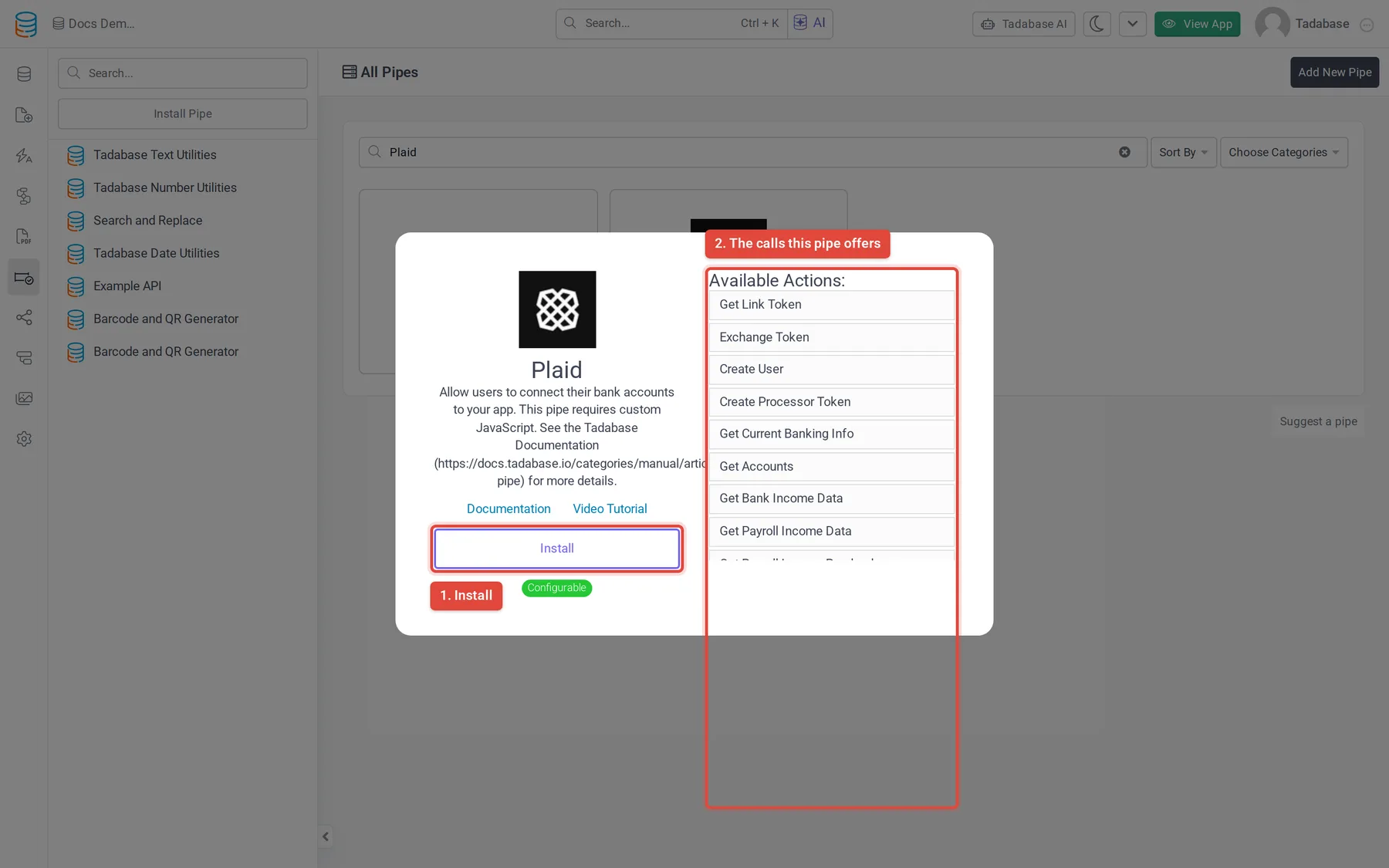
- Open Pipes In the builder, click the Pipes icon in the left menu. The All Pipes page lists every pipe you can install.
- Find the pipe Type
Plaidin the Search... box and click the Plaid card. The window shows what the pipe does and its Available Actions: the calls it offers. - Click Install Click Install. If your plan does not include pipes, an upgrade button shows instead.
- Open Global Parameters The pipe asks for nothing during install. Open the installed Plaid pipe and click Global Parameters.
- Enter your keys Set Client ID to your
client_id, Development Secret to the secret for your environment, and Environment tosandboxorproduction(it starts assandbox). Click Save.
Every call sends the client ID and secret to https://{Environment}.plaid.com from the Tadabase server, so they are not exposed to the browser.
Let users link a bank account #
Linking takes three calls in order: create a link token, open Plaid Link with it, then exchange the public token Plaid Link returns for a permanent access token.
- Add fields to the Users table Add text fields for the Plaid access token (and the Plaid user token if you use income calls). Keep these fields out of every page other users can see: the access token gives ongoing read access to the person's bank data.
- Load the Plaid Link library Add
<script src="https://cdn.plaid.com/link/v2/stable/link-initialize.js"></script>to your app's custom header code. See Custom header and footer code. - Add a button On the page where users connect their bank, add an HTML element with a button, for example
<button id="plaid-connect">Connect your bank</button>. - Copy the Get Link Token code Open the Plaid pipe, click API Calls > Get Link Token > Overview, and click Copy Code. Paste the code into the page's JavaScript (see Page CSS and JavaScript).
- Fill in the parameters Set
nameto your company name,user_idto a unique ID for the logged-in user (such as their record ID), andproductsto the Plaid products you use, each in double quotes, for example"auth","transactions". Your Plaid account must have those products enabled. - Open Plaid Link In the call's callback, create the Plaid Link handler with
response.link_tokenand open it when the button is clicked (see the example below). - Exchange the public token Copy the code of the Exchange Token call the same way and run it from Plaid Link's
onSuccess, passing thepublic_token. Its response holdsaccess_token. - Store the access token Save the access token to the logged-in user's record. One way is to run the Update Existing Record call of the Tadabase Rest API pipe from the same JavaScript.
// Paste the ids from Copy Code in place of these placeholders.
var getLinkToken = 'PASTE_GET_LINK_TOKEN_ID';
var exchangeToken = 'PASTE_EXCHANGE_TOKEN_ID';

TB.triggerPipe(getLinkToken,
  {name: 'My Company', user_id: 'USER_RECORD_ID', products: '"auth","transactions"'},
  function (type, response) {
    var handler = Plaid.create({
      token: response.link_token,
      onSuccess: function (public_token) {
        TB.triggerPipe(exchangeToken, {public_token: public_token},
          function (type, response) {
            // response.access_token: save it to the user's record here.
          });
      }
    });
    $('#plaid-connect').on('click', function () { handler.open(); });
});To test in Sandbox, sign in to any bank in Plaid Link with the user name user_good and password pass_good.
Calls in the pipe #
After a user links an account, run these calls with their access token, for example from a workflow with the Trigger Pipe action. Calls for income, assets and employment need those Plaid products enabled on your Plaid account.
| Group | Call | Parameters |
|---|---|---|
| Link | Get Link Token | Company Name, User ID, Products |
| Link | Exchange Token | Public Token ID |
| Accounts | Get Accounts | Access Token |
| Accounts | Get Account Balance Data | Access Token |
| Accounts | Get Auth Data | Access Token |
| Accounts | Get Identity Data | Access Token |
| Transactions | Get Transaction Updates for an Item | Access Token, Count |
| Assets | Create an Asset Report | Access Tokens, Days Requested |
| Assets | Get an Asset Report | Asset Report Token, Include Insights |
| Income | Create User | Client User ID (returns the User Token the income calls need) |
| Income | Get Bank Income Data | User Token |
| Income | Get Payroll Income Data | User Token |
| Income | Get Payroll Income Precheck | User Token and employer details |
| Income | Get Employment Data | User Token |
| Processors | Create Processor Token | Client User ID, Account ID, Access Token (the processor is set to checkbook in the request) |
More from Plaid #
For what each call returns, see the Plaid API reference and the Plaid Link web guide.
Was this page helpful?
Something wrong or missing on this page? Tell us.